
Review · SPAIN HORSE RIDING TOURS
Jerez de la Frontera: How the Andalusian Horses Dance
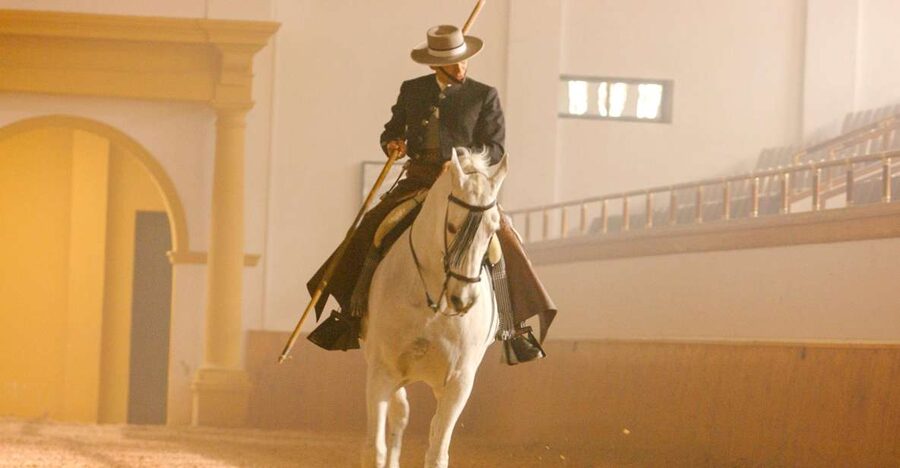
The horses are the stars here, but the real spectacle is the quiet control between horse and rider. At Jerez’s Royal Andalusian School of Equestrian Art, you’ll see Andalusian horses perform pirouettes, piaffe, Spanish walk, carriage work, and group routines in a formal equestrian ballet.
I like the variety of riding styles, from traditional cattle work to refined classical dressage. I also like the old-fashioned setting and costumes, which make the performance feel tied to Spain rather than like a generic horse show. The main thing to consider is that you do not choose a particular row or seat. Seats are assigned by booking order within your ticket category, and the program can change.
Key points to know before booking
- Six to eight choreographies: The program may include classical dressage, Doma Vaquera, carriage driving, work in hand, and a final carrousel.
- A true Jerez specialty: The show presents the training tradition of the Andalusian horse in the city best known for this equestrian art.
- Spanish riding with musical polish: Classical music, Spanish melodies, formal riding, and 18th-century costumes shape the performance.
- Good value at $31: The 90-minute to two-hour admission gives you a full staged performance rather than a short demonstration.
- Easy to pair with Cádiz: You can reach Jerez by train from Cádiz and continue by taxi to the Royal School.
- Plan for ticket rules: Bring your printed voucher and passport or ID card, and do not bring bottles, cans, pets, glass, or recording equipment.
Why this Jerez horse show is special
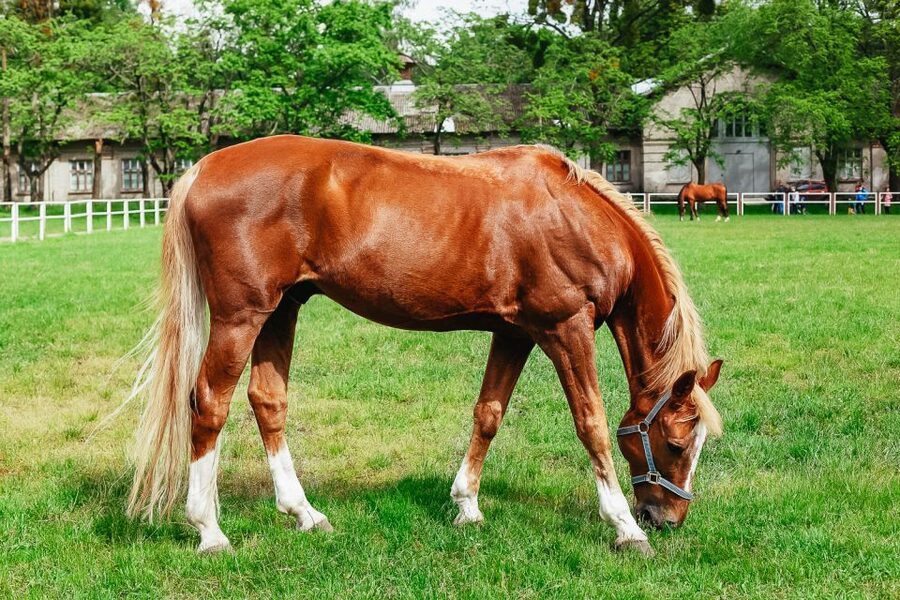
Jerez de la Frontera has a strong connection with horses, and this performance presents that connection in a polished public setting. You are not simply watching riders circle an arena. The show explains, through movement, how the Andalusian horse is trained for control, precision, strength, and obedience.
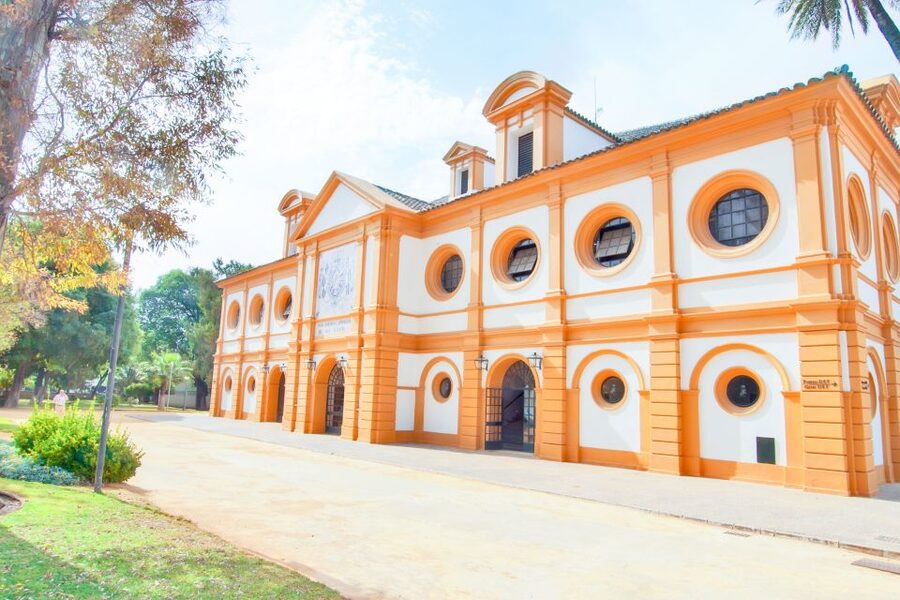
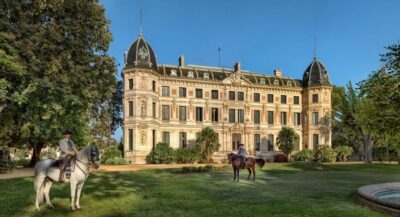
The performance takes place at the Fundación Real Escuela Andaluza del Arte Ecuestre, also known as the Royal Andalusian School of Equestrian Art. Its staged format makes the skills easy to follow, even if you know little about dressage.
The show normally contains six to eight numbers chosen from the school’s repertoire. That means the exact running order may vary, and you should not expect every named exercise at every performance. Still, the selection usually covers several very different sides of Spanish horsemanship.
You’ll see the riders work with horses in formal costumes inspired by the 18th century. The music helps set the pace and gives the performance a theatrical rhythm. At its best, the show feels less like a sports event and more like a carefully arranged ballet in which the horses do the dancing.
More Horse Riding Tours in Spain:
- Cordoba: Equestrian Show General Entry
★ 4.5 · 2,333 reviews - El Salobre: Horse Riding Adventure with Transfer Options
★ 4.5 · 2,034 reviews - Mallorca: Horseback Riding Experience with Food Options
★ 4.6 · 1,424 reviews
Doma Vaquera brings cattle-country riding into the arena
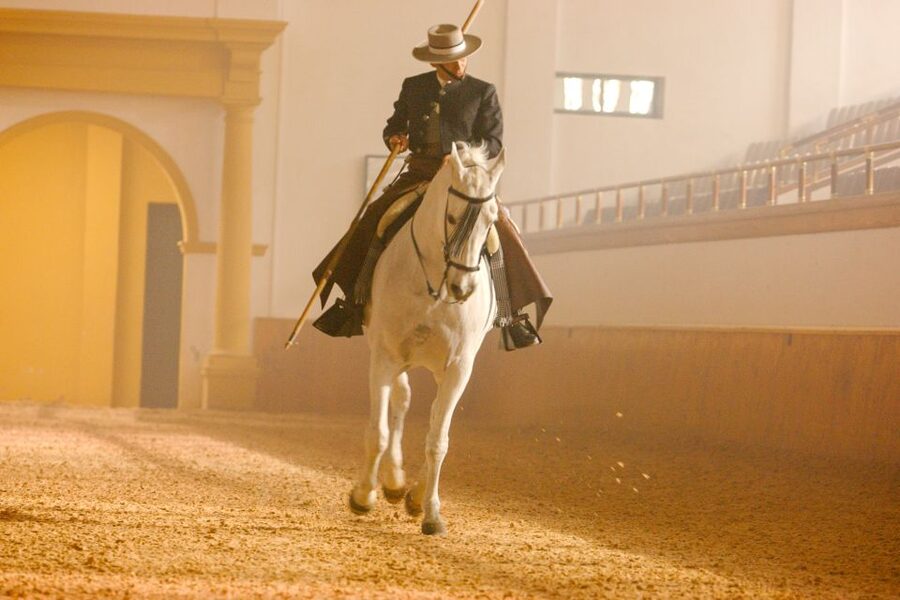
One of the most distinctive sections is Doma Vaquera, a Spanish discipline based on the work of cattle herding. The rider uses one hand and guides the horse through changes in speed, direction, and rhythm.
You may see the horse move from a trot into a gallop, perform a pirouette, or burst forward in an arreón. These movements have practical roots, but inside the arena they become a display of timing and nerve.
This part is especially useful for understanding that Spanish riding is not only about formal dressage. Doma Vaquera comes from working with livestock in the countryside, so the movements have a direct, purposeful quality. I find it one of the best sections for anyone interested in how riding traditions develop from daily work.
The rider’s one-handed control can be easy to miss if you are watching only the horse. Keep an eye on the rider’s posture and hands. The small signals are part of the skill.
Classical dressage turns precision into choreography
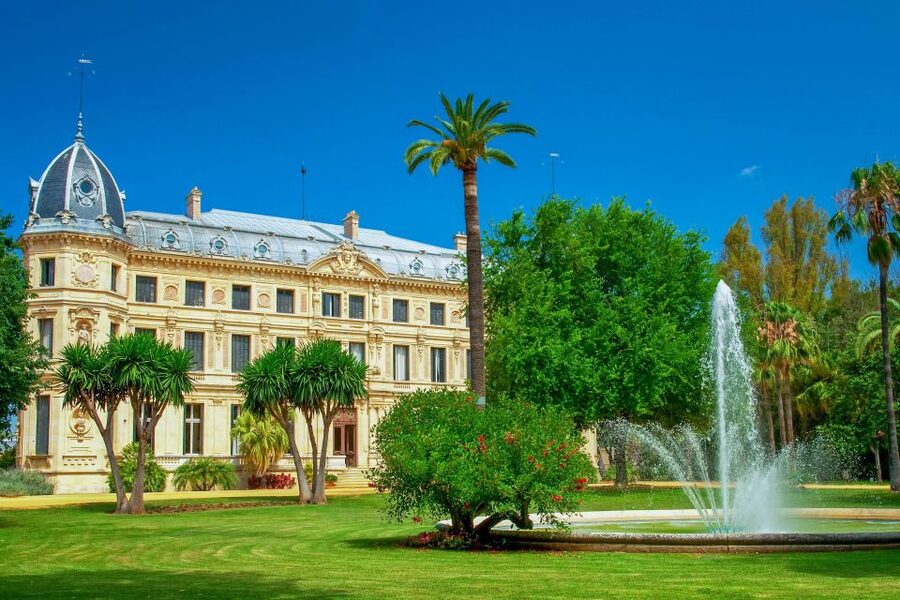
The classical dressage section is likely to be the most familiar part for many people. It may include exercises such as The Colts, Airs on Horseback, Pas de Deux, Passage and Piaffer, Domino on Horseback, Airs Above the Ground, and Fantasy.
A Pas de Deux places two horses and riders together, asking them to move in matching patterns. The effect depends on spacing and timing. A small error would be obvious, which is why the quiet accuracy of the riders matters as much as the more dramatic movements.
Passage and piaffe show the horse’s ability to collect its movement and step with great control. The horse appears to move almost in place, with the rider giving minimal visible instruction. You may find these exercises more subtle than the galloping displays, but they reward close attention.
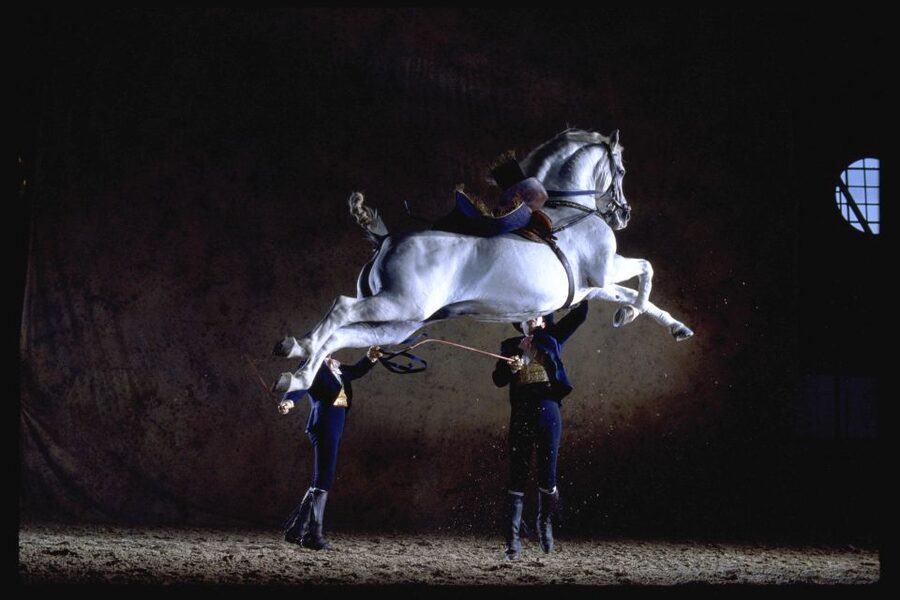
Airs Above the Ground are among the most dramatic movements in classical riding. The horse lifts its front end or performs a powerful elevated movement under precise direction. The school’s program may not include every exercise at each show, so treat the published repertoire as the range of possible numbers rather than a guaranteed sequence.
Carriage driving adds speed, teamwork, and old transport
The carriage-driving section changes the mood of the show. Instead of watching a single mounted rider, you’ll see horses pull carriages while coachmen manage the harnesses, reins, and movement of the vehicle.
These carriages were once practical transport. Here, they are used for sport and exhibition. That shift gives the routine a historical feel, but it is not just a slow parade. The coachmen demonstrate control and dexterity while the horses work together.
This section may appeal to you if you enjoy mechanical detail as much as riding technique. Watch how the horses respond as a group and how the coachman handles the carriage through turns and changes of pace.
It also gives the show some visual variety. After several mounted exercises, the larger carriage makes the arena feel different. The horses are still performing precise work, but the balance now includes harness, wheels, passengers, and the coachman’s position.
Same saddle, a completely different route:
- Jerez de la Frontera: Andalusian Horse Dance and Museums
★ 4.7 · 1,289 reviews - Jerez: Yeguada de la Cartuja Carthusian Horses Tour
★ 4.8 · 970 reviews - Jerez: Royal Andalusian School of Equestrian Art Admission
★ 4.6 · 882 reviews - Tenerife: Horseback Ride with Instructor
★ 4.4 · 836 reviews
Work in hand shows obedience without a rider
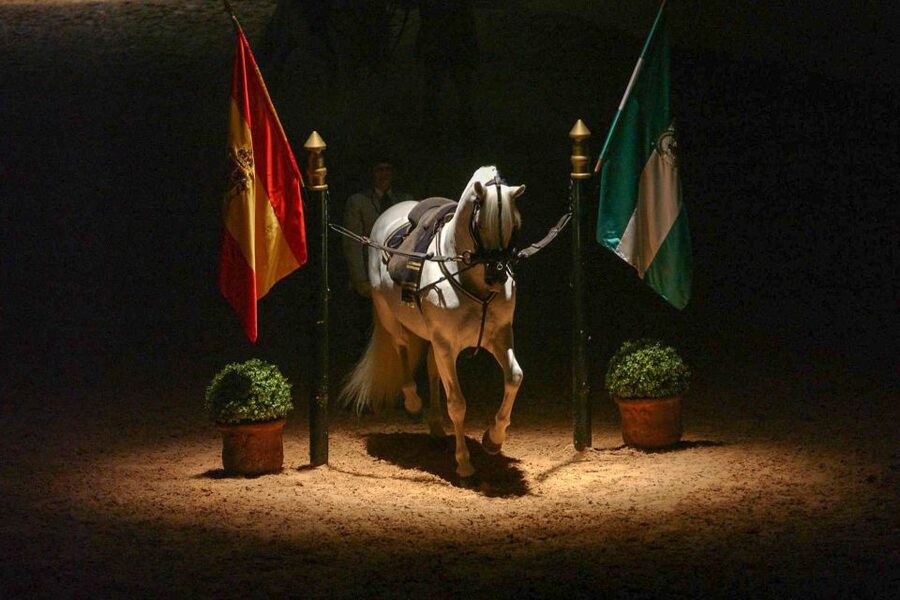
Work in hand is a fine reminder that the horse’s training does not depend only on a rider sitting in the saddle. The horse follows instructions while the horseman remains on the ground.
The school may present Haute École exercises such as levades, caprioles, courbettes, piaffe between pillars, and the Spanish walk. These are demanding movements, and the horse must respond to small signals from the handler.
The Spanish walk is easy to recognize because the horse lifts its front legs in an exaggerated, controlled step. Other movements are more specialized, but the main point is the same: the horse remains attentive and responsive without the weight of a rider.
I like this section because it makes the relationship between training and performance easier to see. A rider can sometimes hide a horse’s uncertainty through posture or reins. On the ground, the horse’s focus is more exposed.
The carrousel gives the performance its grand finish
The carrousel usually provides the closing number. A group of horses and riders performs advanced exercises together, creating a wide pattern of movement across the arena.
Group riding demands more than individual skill. Each rider must maintain spacing, direction, and pace while responding to the other horses. The visual effect is orderly and formal, which suits the school’s traditional style.
If you are choosing where to focus your attention, watch the riders at the edges of the formation. It is easy to look only at the center, but the outer riders help keep the whole pattern balanced.
The carrousel is a fitting finale because it brings together the show’s main ideas: training, timing, teamwork, and presentation. It also gives you a final chance to see several Andalusian horses moving as one coordinated group.
Music, costumes, and presentation
Music is not a side detail here. It gives the numbers their pace and helps divide the show into separate moods. You’ll hear quintessential Spanish music alongside classical dressage routines.
The 18th-century style costumes reinforce the connection to older riding traditions. The formal clothing, traditional tack, and carefully presented horses make the performance feel ceremonial.
This visual style will appeal to you if you enjoy cultural performances as much as sport. It also means the show is designed for an audience that may not know the technical names of every movement. The music and costumes help communicate the character of each number.
At the same time, this is a formal exhibition, not an informal stable visit. You should come expecting a polished performance with planned choreography. If you want a rough-and-ready look at everyday ranch work, Doma Vaquera offers some of that background, but the event itself remains carefully staged.
How long the show lasts and how the seating works
Allow between 90 minutes and two hours. The exact duration can vary with the program, so avoid arranging a tight connection immediately afterward.
Tickets are sold by category rather than by a specific row or seat number. The seat is assigned according to the order of purchase or booking within that category. You cannot select your exact position, so keep this in mind if you are particular about where you sit.
The practical upside is that the entire show is designed for viewing from the stands, and a recent booking note specifically praised the visibility from all seats. Still, your view may not be identical to someone who books earlier or chooses a different price category.
The show is wheelchair accessible. If accessibility is important to you, check the booking details for the arrangement that applies to your ticket before you go.
Is $31 a fair price?
At $31 per person, I consider this a reasonable price for a full performance lasting up to two hours. You are paying for a complete equestrian production with several different forms of riding, not just a brief appearance by a few horses.
The value is strongest if you already plan to visit Jerez or are staying in Cádiz for several days. The show gives you a cultural activity that is closely tied to the area, rather than a standard sightseeing stop that could happen anywhere.
The price may feel less attractive if you have little interest in horses, dressage, or formal performances. Some of the movements are subtle, and the show’s pace is controlled rather than constantly dramatic. Children and first-time viewers may enjoy the costumes, music, and galloping sections, but younger children may not follow the technical parts.
Discounted tickets require proof of eligibility at the box office. If you cannot show the required documentation, you may need to pay the difference up to the standard ticket price, if seats remain available.
Getting to the Royal Andalusian School
The meeting point is the reservation box office at the Royal Andalusian School of Equestrian Art Foundation. You must present your printed voucher there, so do not rely only on a digital copy unless the booking instructions clearly allow it.
From Cádiz, a train to Jerez followed by a short taxi ride is a practical option. The route is useful if you are spending several days in Cádiz and want to make Jerez a half-day or full-day outing.
The supplied information does not give a precise journey time, train timetable, or taxi fare. Check those details for your date instead of assuming the connection will fit neatly around the show.
Bring your passport or ID card. This is particularly important if the box office asks you to confirm booking details or eligibility for a reduced price.
What you can and cannot bring
The school does not allow pets, flash photography, glass objects, audio recording equipment, weapons, or sharp objects. Bottles and cans are also not permitted, along with anything management considers unsuitable.
Do not use flash during the show. Flash can distract horses and spoil the performance for people around you.
The rules are stricter than at a casual outdoor attraction, so pack lightly. A printed voucher, identification, and personal essentials are the safest approach.
Photography without flash may be allowed, but the stated restrictions are the ones to follow. If you are unsure, ask at the venue rather than risking a problem at the entrance.
Should you add the show to your Jerez plans?
I would book this if you want to see a distinctly Andalusian performance and you have at least 90 minutes to spare. It is especially well suited to people who enjoy horses, dressage, Spanish traditions, or carefully staged cultural events.
I would also recommend it to anyone based in Cádiz who wants a worthwhile outing to Jerez. The train and taxi combination makes the trip manageable, and the show gives you a strong reason to visit beyond simply passing through.
Think twice if you dislike formal performances or have no patience for slow, precise movement. The show includes speed and drama, but its best moments often come from tiny corrections, controlled steps, and synchronized patterns.
For most visitors interested in Andalusia, the combination of horsemanship, music, costumes, and local tradition makes the $31 ticket a sensible purchase. Book earlier if seat position matters to you, bring the printed voucher and identification, and keep your expectations focused on equestrian art rather than a casual animal encounter.
FAQ
Where does the Andalusian horse show take place?
It takes place at the Fundación Real Escuela Andaluza del Arte Ecuestre, or Royal Andalusian School of Equestrian Art, in Jerez de la Frontera.
How long does the performance last?
The stated duration is between 90 minutes and two hours.
How much does admission cost?
The listed price is $31 per person.
What types of riding are included?
The program may include Doma Vaquera, classical dressage, carriage driving, work in hand, and a carrousel.
Will I see a Pas de Deux?
A Pas de Deux is part of the school’s classical dressage repertoire, but the management chooses the specific six to eight choreographies for each performance.
Is the show wheelchair accessible?
Yes, the experience is listed as wheelchair accessible.
Can I choose my exact seat?
No. Tickets are sold by price category, and rows and seat numbers are assigned according to the order of purchase or booking.
What identification should I bring?
Bring your passport or ID card. If you bought a discounted ticket, also bring proof of eligibility.
Can I take photographs?
Flash photography is not allowed. Audio recording is also prohibited.
Can I cancel my booking?
You can cancel up to 24 hours in advance for a full refund. The activity also offers a reserve-now-and-pay-later option.
Just added around Spain
- Horseback Riding by the beach or mountain in Tarifa, Spain – 1 to 2 hrs★ 5.0 · 3 reviews
- Horseback riding through the Calblanque Natural Park★ 3.5 · 12 reviews
- Horseback riding route through Doñana + visit to El Rocio-Private tour★ 4.0 · 2 reviews
- Private Horse Carriage Ride and Walking Tour of Seville★ 4.5 · 4 reviews
- Seville Palaces: Dueñas Palace and Pilate House Tour★ 5.0 · 28 reviews
- Jerez and Cadiz with Horse Ballet and Sherry Tasting from Seville★ 4.5 · 45 reviews
- Horseback riding tour of Doñana and visit of El Rocio★ 4.5 · 4 reviews
- Donana National Park Horse or 4×4 Riding Day Trip★ 5.0 · 4 reviews
Spain Horse Riding Tours, compared.
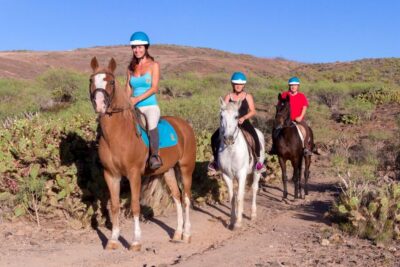
El Salobre: Horse Riding Adventure with Transfer Options
Read our review →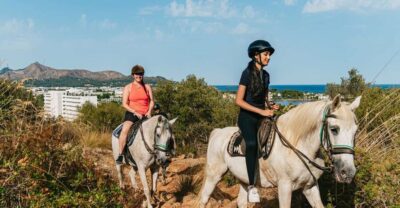
Horseback Riding Experience with Food Options
Read our review →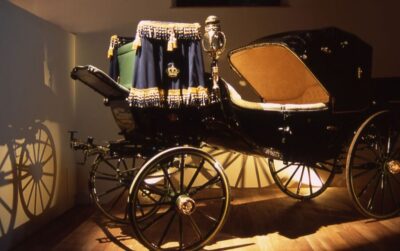
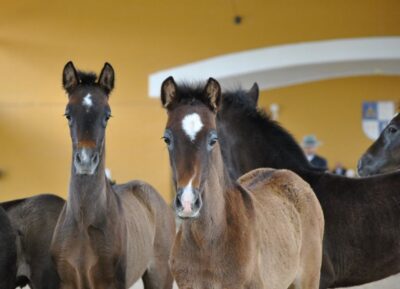
Royal Andalusian School of Equestrian Art Admission
Read our review →
Montserrat Monastery & Horse Riding Experience from Barcelona
Read our review →Browse the lists this tour appears in