
Review · TOKYO HORSE RIDING TOURS
Watch Sumo Morning Practice at Stable in Tokyo
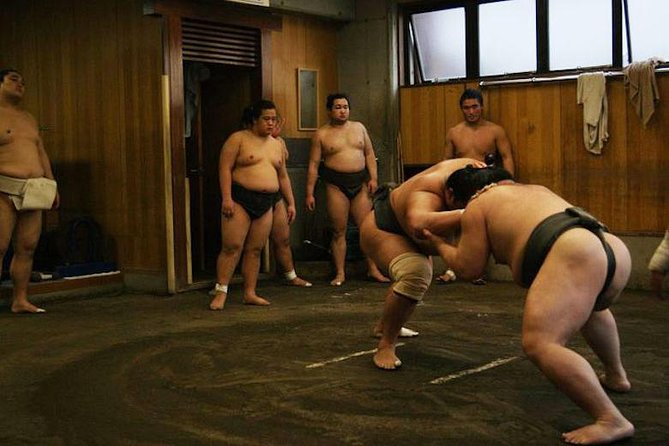
Sumo morning practice gives you something a tournament cannot: a quiet look at the daily work behind Japan’s national sport. At a Tokyo stable, you sit close to the dohyo and watch wrestlers stretch, stamp, push, grapple, joke, advise younger athletes, and gradually build toward hard sparring. This is training, not a staged show.
I like the close view of genuine practice and the chance to see the sport’s rituals before competition. I also like that the small-group format, with a maximum of 10 people listed for the activity, offers a more personal setting than a large arena event. The main drawback is simple: you sit on the floor for a long time, often in near silence, and the end time can change without warning.
- Morning training at a real stable: Watch warmups, stretching, drills, and contact practice where wrestlers prepare for competition.
- A quiet, respectful setting: You must avoid loud talking, eating, intrusive sounds, and bright camera flashes.
- Floor seating matters: You may sit for 60 to 90 minutes, and sometimes close to two hours depending on the schedule.
- Practice length changes: During Tokyo tournament periods in January, May, and September, practice may last only 30 to 40 minutes.
- Photos are included: A photo opportunity with the wrestlers is scheduled at the end, though late finishes can affect it.
- Book well ahead: This experience is often reserved about 62 days in advance, while the stable schedule may be confirmed only about a week before.
Why Sumo Practice Feels Different From a Tournament
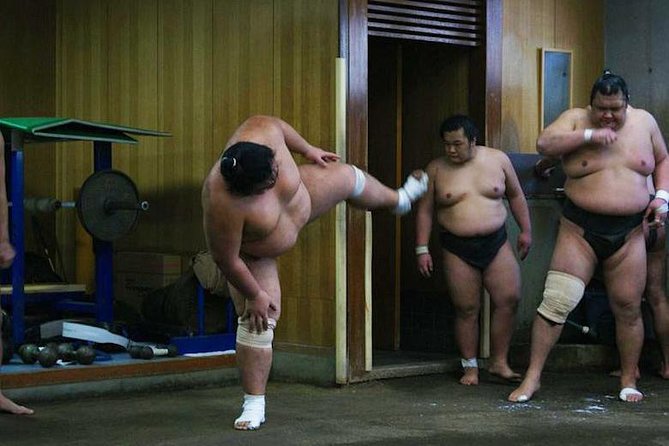
A sumo tournament is polished and public. Morning practice is rawer. You see wrestlers repeating basic movements, correcting one another, and working through a routine that may look slow at first but builds toward startling physical force.
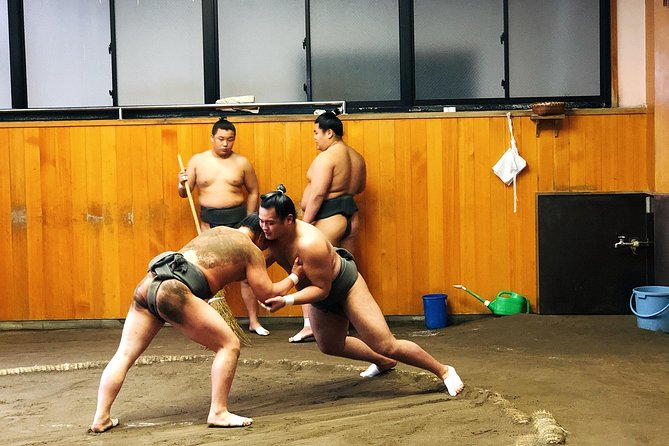
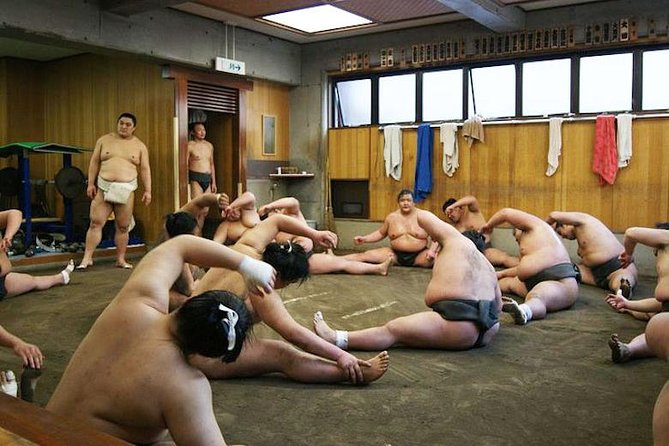
The session commonly begins with stretching and warmups. Wrestlers then practice movements and techniques in the dohyo, the raised ring used for sumo bouts. The contact work can be brief or intense, depending on the day. You might first see controlled drills, followed by repeated clashes and sparring between larger, more experienced wrestlers.
That slow build is part of the appeal. Sumo is not simply two enormous men crashing into each other. The wrestlers train balance, timing, footwork, grip, posture, and the ability to absorb impact. From the side of the ring, you can see how much preparation goes into a few seconds of action.
I find the setting most valuable if you approach it as a sports practice, not entertainment. There may be long stretches of repetition. A wrestler might perform the same movement many times, and there is no promise of constant action. That is precisely what makes the experience feel genuine, but it can test anyone expecting a fast-moving performance.
Arriving in Ryogoku and Finding the Stable
The activity starts at a meeting point in Tokyo and ends back there. The itinerary identifies Ryogoku Kokugikan as the stop, though the exact stable location and conditions depend on the stable’s schedule. The final address may be sent only a few days before the visit, and the stable itself can be difficult to locate without careful directions.
Give yourself extra time. The sumo district is easy to reach in general, but the stable may sit away from the most obvious tourist route. Some people have found a taxi from Asakusa useful, especially when carrying luggage or traveling early in the morning. If you take a taxi, keep the address in Japanese, since not every driver can read an English address.
The prearranged meeting point helps. You do not have to search for an open training session on your own or guess which door to use. A representative meets the group and takes you inside. Still, you should not treat the meeting as a full guided tour unless your booking specifically confirms that.
This point matters because the amount of explanation can vary. Some groups have had guides who explained sumo history and customs, while others received little more than an introduction and directions to their seats. If learning the rules is important to you, read about the wrestler hierarchy, basic techniques, and ring etiquette before you go.
More Sunrise and Morning Trips in the world:
- Cappadocia: Horseback Tour with Sunrise and Sunset Options
★ 4.9 · 1,755 reviews - Morning Horseback Ride with Breakfast from Las Vegas
★ 5.0 · 1,674 reviews - Cappadocia: Horse Riding Tour with Sunrise or Sunset Options
★ 4.8 · 1,377 reviews
Inside the Stable: Quiet Observation and Close Action
Once inside, you take a place on the floor or on a low raised area. The group watches from the side while the wrestlers carry on with practice. You are not being invited to participate, and the atmosphere depends on your ability to observe without interrupting.
The rules are strict but sensible:
- Do not eat or drink during practice.
- Keep conversation to a minimum.
- Do not use bright flash photography.
- Avoid camera sounds or other intrusive noise.
- Do not point your feet toward the ring or behave casually in a way that distracts the wrestlers.
You may see wrestlers stretch, warm up, practice footwork, and work through repeated techniques before contact begins. The wrestlers may also talk among themselves, tease one another, or offer advice. Those small moments can be as interesting as the collisions because they show the stable as a working team, not a theater set.
The strongest part of the session is often the first serious contact. The impact is far louder and harder than photographs suggest. You can see the strain in the wrestlers’ legs and shoulders, and you begin to understand why balance and timing matter so much in a sport that may last only seconds.
The viewing position is important. Sitting near the front gives you a much clearer sightline. If you arrive late, taller people may block parts of the ring, and a coach or another seated person can sometimes obstruct your view. Some seats are better than others, so arrive early when the meeting instructions allow it.
Floor Seating Is the Big Practical Issue
This is not a chair-based sightseeing stop. The activity requires sitting on the floor for an extended period, often with your legs folded or tucked to one side. The surface may be a thin tatami mat over a hard floor. For many people, the discomfort becomes the main issue rather than the sumo itself.
A limited number of chairs or stools may be available on request, but they can offer a poorer view. Do not assume that asking for a chair guarantees a comfortable front-row seat. If you have back, hip, knee, or leg problems, contact the provider before booking and ask what seating can be arranged.
The activity lists a minimum age of 13. That age limit makes sense because visitors must remain quiet and still for a long stretch. Teenagers who already enjoy sports or Japanese culture may find the session absorbing, but younger children could struggle with the silence and repeated drills.
Wear practical clothing. You need to sit comfortably and avoid anything that makes it hard to fold your legs. Bring only what you need, since a small stable is not the place to spread out bags or move around during training.
How Long the Visit Really Takes
The advertised experience can sound like a two-hour outing, but actual practice is generally listed as 60 to 90 minutes. The ending time varies each day because the wrestlers decide their training schedule, not the tour company.
That flexibility creates a possible problem if you have a train, meal reservation, airport transfer, or another timed activity afterward. Leave a generous buffer after the practice. A session that runs long may also reduce or eliminate the planned photo time. One important complaint about this experience came from people who enjoyed the training but missed the photos because the practice ended late.
Tournament periods create the opposite problem. Tokyo tournaments take place in January, May, and September, usually around the middle to later part of the month. During those periods, the stable may be closed, or practice may be shortened to 30 to 40 minutes. The price does not change when the practice is shorter.
Stable conditions can be confirmed only about one week before the visit. Tournament schedules and stable routines change from year to year, so check the final information carefully rather than assuming the schedule from a previous trip will apply.
The listed operating dates include Monday through Saturday, 8:00 a.m. to 10:00 a.m., during February 2 to 14, March 31 to April 30, and May 1 to 9, 2026. The early start is part of the experience, but it also means you need to plan your Tokyo morning around transport and the uncertain finish.
Same saddle, a completely different route:
- Charleston’s Old South Carriage Historic Horse & Carriage Tour
★ 5.0 · 10,023 reviews - Jerez de la Frontera: How the Andalusian Horses Dance
★ 4.6 · 6,168 reviews - Punta Cana Zipline Adventure with Buggies and Horseback Riding
★ 5.0 · 5,001 reviews - Luquillo Beach Horse Ride from Carabalí Rainforest Adventure Park
★ 5.0 · 4,762 reviews
The Photo Session and What It Is Worth
Photos with the wrestlers are included in the entrance fee. This is a nice closing touch, especially after sitting quietly and observing from the side of the ring. It gives you a personal memory of the visit without changing the practice into a performance for cameras.
Keep your expectations realistic. The photo session is usually brief, and it may not happen if practice runs beyond the available time. You should also follow instructions closely. The wrestlers have just completed training, and the photo opportunity is a courtesy, not the central purpose of the visit.
If the photo is essential to you, avoid scheduling anything immediately afterward. A late finish can create a choice between staying for the photo and leaving to make your next appointment.
Does the $95.77 Price Offer Good Value?
At $95.77 per person, this is not a cheap way to fill an hour in Tokyo. You are paying for access to a setting that most independent visitors cannot simply enter, plus the arrangements needed to meet at the correct place and observe without disrupting practice.
The value is strongest for people who care about sumo, Japanese customs, or serious athletic training. Seeing the wrestlers close to the ring can make the price feel fair, especially if you would otherwise spend a large part of your Tokyo visit trying to find a stable with no guarantee of entry.
The value is weaker if you want a narrated cultural tour, a long photo session, or guaranteed entertainment. Food and drinks are not included. The group may also be larger in practice than the small-group description suggests in some arrangements, which can make seating and sightlines less comfortable.
Group discounts are available, so the cost may work better for families or parties booking together. Still, calculate the total against your priorities. A first-time visitor who wants broad cultural context may prefer a tour that clearly includes a guide and explanations. A sumo fan may consider this a fair price for the access alone.
Who Will Enjoy This Most
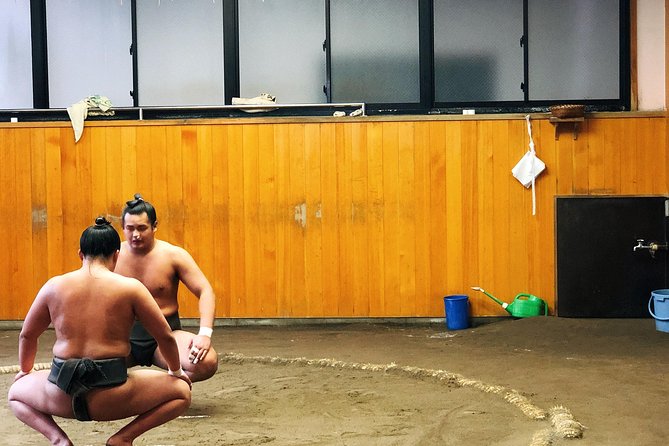
I would recommend this to you if you enjoy watching athletes train, appreciate ritual, or want a close look at a side of Tokyo that is not arranged for mass sightseeing. It suits adults and teenagers who can sit quietly and accept that repetition is part of the experience.
It is especially good for:
- Sumo fans who cannot attend a tournament.
- Sports-minded visitors who enjoy seeing technique develop.
- People who value authentic daily practice over a staged cultural display.
- Families with teenagers aged 13 and older.
- Visitors already staying near Asakusa, Ryogoku, or another well-connected part of eastern Tokyo.
Think carefully before booking if you have trouble sitting on the floor, need a guaranteed chair, dislike quiet observation, or have a tightly scheduled morning. It may also disappoint you if you expect constant wrestling. The warmup and stretching can take a substantial part of the session.
A little preparation helps. Watch a sumo documentary, read about the wrestler ranks, and learn the basic idea of winning by forcing an opponent out of the ring or making him touch the ground with something other than the soles of his feet. You will recognize more of what is happening and get more from the quiet moments.
Booking Timing and Cancellation Rules
This experience is often booked about 62 days ahead, which is useful to know if your Tokyo dates are fixed. Confirmation arrives within 48 hours, subject to availability, but the stable schedule may not be final until roughly one week before the visit.
The cancellation terms are strict close to the date. Cancel at least six full days before the start time for a full refund. A cancellation two to six full days ahead receives a 50 percent refund, while cancelling less than two full days ahead receives no refund. Changes are not accepted inside three days, including changes caused by flight delays or illness.
The activity requires suitable weather. If poor weather causes cancellation, you are offered another date or a full refund. Since the exact practice schedule is also outside the operator’s control, keep checking your messages before the visit.
My Take: Book It for the Practice, Not the Show
I would book this experience if I wanted to see how sumo works before the tournament lights and crowds. The close range, serious training, powerful contact, and small details of stable life can make it one of the more memorable cultural activities in Tokyo.
I would not book it expecting a polished presentation. Explanations may be limited, seating can be hard, the group may affect your view, and the photo session is not guaranteed if the practice runs long. For the right person, those limits are part of the bargain: you are observing a working training session, not attending a theme-park attraction.
Book it if you can sit on the floor, stay quiet, arrive early, and leave your morning open. Skip it if comfort, a fixed timetable, or constant narration matters more than access to authentic practice.
FAQ
How long does the sumo practice last?
The practice generally lasts 60 to 90 minutes. During Tokyo tournament periods in January, May, and September, it may last only 30 to 40 minutes.
Is the activity really two hours long?
The full visit may take close to two hours, but the actual practice duration varies. The ending time is not fixed and may change each day.
Where does the activity start?
You meet in Tokyo at a prearranged meeting point. Ryogoku Kokugikan is identified as the itinerary stop, and the exact stable address may be provided shortly before the visit.
Can I take photographs during practice?
You may take photographs only within the stable’s rules. Bright flashes, intrusive camera sounds, loud talking, and other distractions are not allowed. Photos with the wrestlers are included at the end.
Do I have to sit on the floor?
Yes. Participants should be able to sit on the floor for an extended period. A limited number of chairs or stools may be available by request, but seating arrangements should be checked before booking.
Is food included?
No. The activity does not include food or beverages.
What is the minimum age?
The minimum age is 13.
Can I cancel for a full refund?
You can receive a full refund if you cancel at least six full days before the experience start time. A 50 percent refund applies for cancellations two to six full days ahead, and cancellations less than two full days ahead are not refunded.
Just added around the world
- Horse Ride + Swimming with Turtles in Aquarium at Nungwi Beach★ 4.5 · 8 reviews
- Xi’an Half-Day Private Tour of Terracotta Warriors and Horses Museum★ 5.0 · 2 reviews
- Desert Trail in Morocco on Horseback★ 5.0 · 2 reviews
- Zakytnhos Horse Riding Swimming Experience★ 3.5 · 3 reviews
- Beach & countryside horse riding outside Westport. Guided. 1 hour★ 5.0 · 56 reviews
- Private tour to Sevan, Dilijan Off-road tour & Horseback riding★ 4.5 · 5 reviews
- Half-Day Tour: Terracotta Warriors and Horses Museum★ 5.0 · 7 reviews
- Vienna Horse-Drawn Carriage Ride with Sparkling Wine and Food★ 5.0 · 44 reviews
Tokyo Horse Riding Tours, compared.
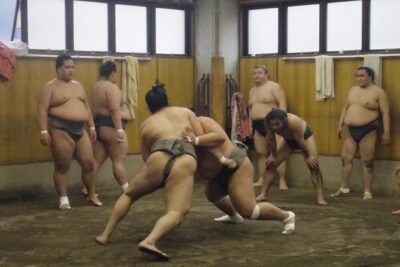
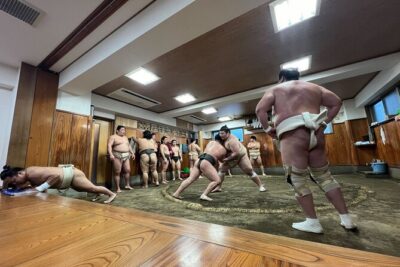
Tokyo Sumo Morning Training/ Sumo Practice with Wrestlers
Read our review →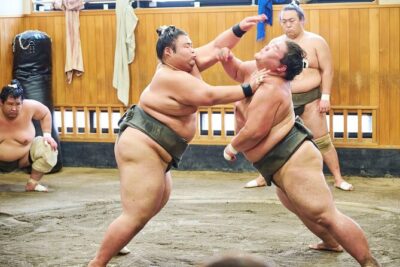
Tokyo: Sumo Morning Practice Viewing Tour at a Real Stable
Read our review →Tokyo: Sumo Morning Practice Viewing Tour at a Real Stable
Read our review →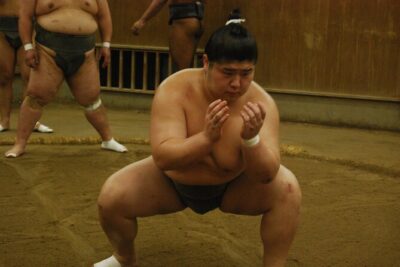
Tokyo: Sumo Morning Practice -Stable Visit Tour with a Guide
Read our review →Tokyo: Sumo Morning Practice -Stable Visit Tour with a Guide
Read our review →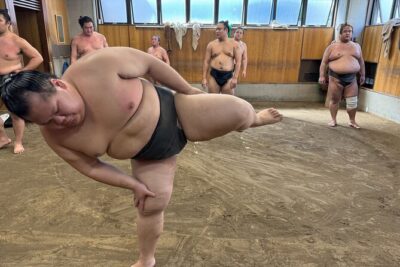
TOKYO , No1 Yokozuna Stable Morning Practice in Ryogoku
Read our review →Browse the lists this tour appears in